
MLIS Students will…
Navigate, curate and create information across the spectrum of human records.
Outcome 3a: Design resources or tools that facilitate access to information.
Resources for Lung Cancer Patients & Caregivers
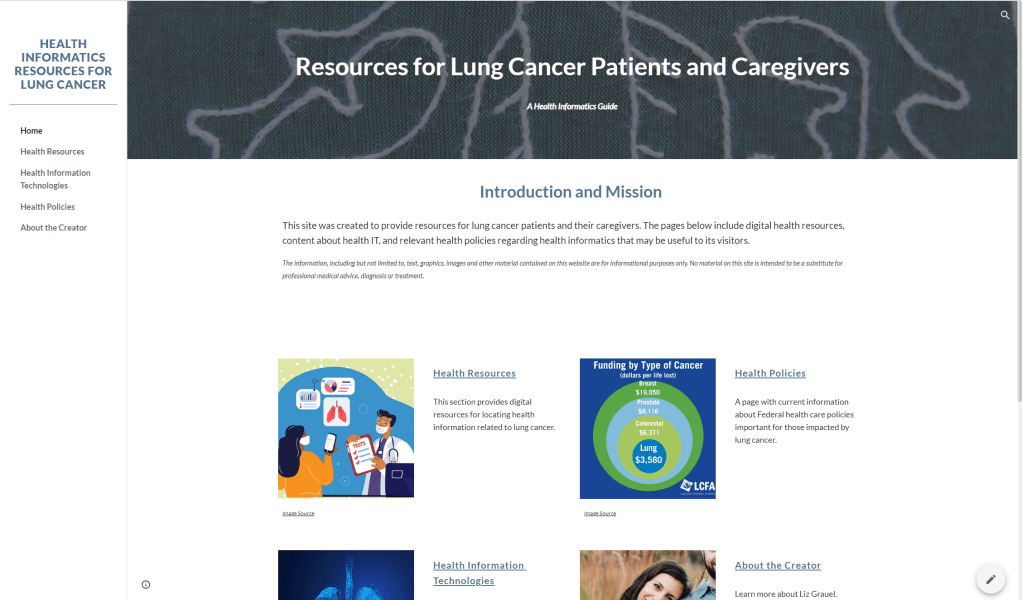
These artifacts were created in Summer 2022 as coursework for Foundations of Health Informatics (LIS-794). First is the Resources for Lung Cancer Patients and Caregivers website, designed as a resource facilitating access to information (Outcome 3a) as a response to assessed information needs for the community (Outcome 2c). Google Sites was used as a tool to manage information for this project (Outcome 3b).
In this project, an online content management system (CMS) was designed and populated with content relevant to lung cancer patients and caregivers. The CMS was built using Google Sites and uses a simple structure to organize information into five pages, serving as a health informatics resource where a specific population can locate services, tools, and other sources of information that are relevant to their healthcare. The accompanying presentation provides an overview of the project. These artifacts provide evidence of the ability to curate information and create information resources with simple navigation appropriate for the audience’s information needs.
Additional Outcomes Fulfilled:
3b, 2c
Artifacts:
Outcome 3b: Utilize resources or tools to manage information
Organization of Knowledge
This artifact is the document submitted as the final exam for Organization of Knowledge (LIS-703) in Summer 2022. It demonstrates the use of various resources and tools, including the RDA Toolkit, Classification Web, OCLC Connexion Browser, and the OCLC Bibliographic Formats & Standards website, in the management and organization of information (Outcome 3b).
This document includes responses to questions requiring reflection and coherent response to demonstrate understanding of Simple Dublin Core XML encoding and the FRBR method of information description for cataloging, and demonstrates an understanding of variable and fixed MARC fields through the creation of two MARC records. This provides evidence of the ability to navigate and create data, metadata, and information.
Outcome 3c: Evaluate resources or tools that manage and facilitate access to information
Book Review: The Intersectional Internet
“Traffic jams on the information superhighway: The Intersectional Internet as a roadmap for progressive research was published in the Critical Race Theory Special Issue of Education for Information in December 2022. The reviewed work discusses methods of evaluating internet and digital technologies as they manage and facilitate access to information (Outcome 3c and 4b) while demonstrating how the theoretical frame of Intersectional Critical Race Technology Studies can guide research in information studies (Outcome 1a). This artifact was created extracurricularly in 2022 and shows participation in professional activities (Outcome 1c).
This book review is a meta-evaluation of resources and tools that facilitate access to information, advocating for the use of progressive research techniques and theoretical lenses when interrogating information and communication technologies and media. It discusses methods of evaluating both human interactions with technology and the design, construction, and application of technology in creating, disseminating, and accessing information. This artifact presents evidence of an understanding of the navigation, curation, and creation of information across a wide spectrum.
Additional Outcomes Fulfilled:
4b; 1a; 1c
Artifact:
 Liz Grauel e-Portfolio